
Learn how to delete Windows services via CMD and Registry. A practical guide for IT pros and gamers. Boost system performance safely.
Windows services run in the background to handle updates, networking, or security. Over time, leftover services from uninstalled apps waste memory and slow down your PC. That is why knowing how to delete Windows service entries is a valuable skill for IT professionals, technicians, and gamers who want a lean and responsive system.
This guide covers two reliable methods: using Command Prompt (CMD) with the sc delete command, and editing the Windows Registry. Each step is explained in detail, including risks and precautions. The instructions work on Windows 10, Windows 11, Windows Server, and older versions like 8.1 and 7. By following this guide, you can remove junk services without breaking system stability.
⚠️ Critical warning: Never delete built-in Windows services like Dhcp, Spooler, or WSearch. Removing the wrong service can cause system errors or application failures. Always create a restore point before you proceed.
Step 1: Identify the Exact Service Name
Before deletion, you must find the internal Service name, not the display name. Windows provides the Services Manager for this task.
Here is how to open Services Manager:
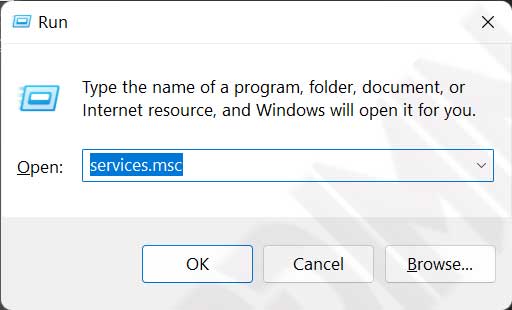
- Press Win + R to open the Run dialog.
- Type
services.mscand press Enter. - The Services window shows all installed services.
Once the window opens, locate the service you want to remove. For technicians and gamers, common targets include:
- AdobeARMservice – Adobe Acrobat update service that consumes memory.
- Bonjour Service – From Apple, not needed if you have no Apple devices.
- SkypeUpdate – Leftover from older Skype versions.
- GameInput Service – Safe to remove if supporting games are gone.
To get the internal name:
- Right-click the target service and choose Properties.
- In the General tab, find the Service name field.
- Write down the exact name (case-sensitive).
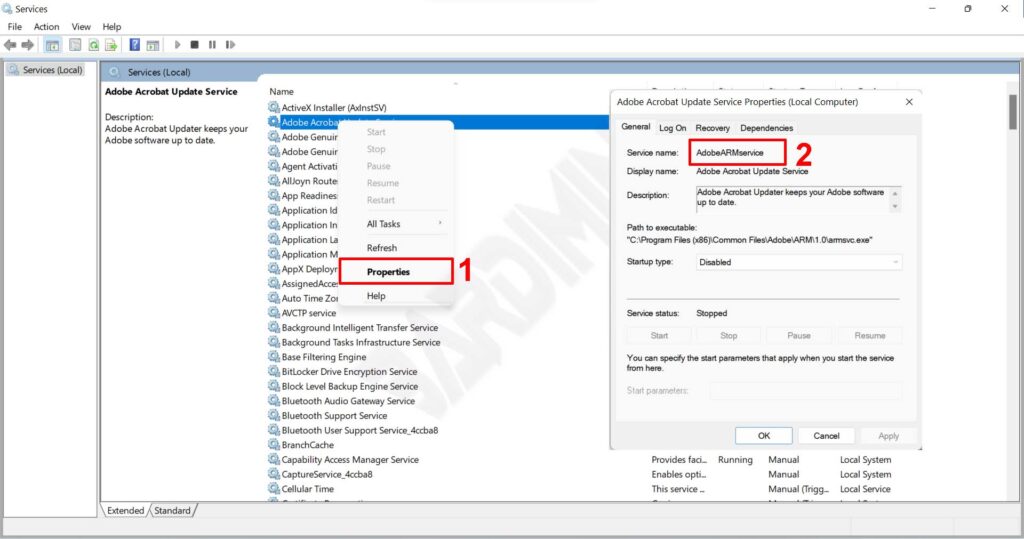
Make sure you type the service name without extra spaces. A single character mistake will cause the command to fail.
Method 1: Delete Windows Service via Command Prompt (CMD)
This method is the fastest and recommended for professionals. The sc delete command removes the service entry directly from the Windows database.
Detailed steps:
- Open CMD as Administrator:
- Click Start, type
cmd. - Right-click Command Prompt and select Run as administrator.
- Click Start, type
- In the CMD window, type the following command:
sc delete <ServiceName>
Example:sc delete AdobeARMservice - Press Enter. On success, you will see [SC] DeleteService SUCCESS.
- Restart your computer to clear the service cache.
C:\Windows\system32>sc delete AdobeARMservice
[SC] DeleteService SUCCESS

This command requires no additional confirmation. Therefore, double-check the service name before hitting Enter. If the service is currently running, Windows marks it for deletion after the next reboot.
For gamers: Remove anti-cheat services like EasyAntiCheat or BattlEye only if the associated game is uninstalled. Deleting these services may prevent games from launching.
Method 2: Delete Service via Windows Registry
The Registry is Windows’ configuration database. This manual method is useful when CMD is unavailable or you need deeper control.
Steps:
- Open Registry Editor:
- Press Win + R, type
regedit, then Enter. - Approve the UAC prompt if it appears.
- Press Win + R, type
- Navigate to:
HKEY_LOCAL_MACHINE\SYSTEM\CurrentControlSet\Services - Find the subkey with the exact Service name (e.g., AdobeARMservice).
- Right-click that subkey and select Delete.
- Confirm deletion by clicking Yes.
- Restart your computer.
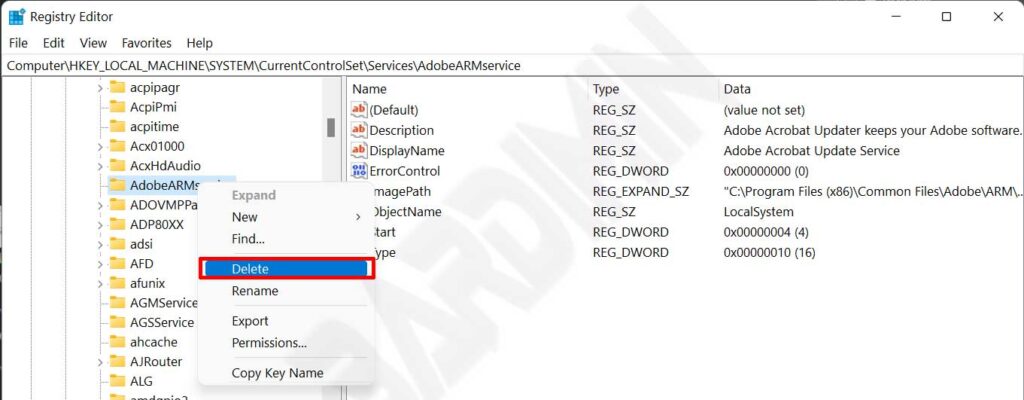
The advantage of this method is that you can see full service attributes, such as ImagePath pointing to the .exe file. However, the risk is higher. Always create a system restore point before editing the registry.
Alternative Method: Using PowerShell to Remove a Service
PowerShell offers a more flexible approach. On Windows 10/11 with PowerShell 5.1 or later, use this command:
Get-WmiObject -Class Win32_Service -Filter "Name='AdobeARMservice'" | Invoke-WmiMethod -Name Delete
Run PowerShell as Administrator, then paste the command above. Replace AdobeARMservice with your target name. This method is just as effective as sc delete and gives more structured output.
Risks and Best Practices
Deleting the wrong service can be fatal. Follow these guidelines to minimize risk:
- Never remove Microsoft built-in services like RpcSs, W32Time, or SecurityHealthService.
- Use Autoruns from Sysinternals to view and temporarily disable services before deletion.
- If the service belongs to an application, uninstall that application first. The uninstaller usually cleans up its own services automatically.
- After deleting a service, run
sfc /scannowin an elevated CMD to check system integrity.
💡 Pro tip: Keep a log of changes you make. Use the command sc query state= all to export a list of services before deletion. Save it as a reference.
Conclusion
Knowing how to delete Windows service entries effectively can be done via CMD using sc delete or through the Registry Editor. For professionals and technicians, the CMD method is faster and less error-prone. Gamers should only remove old game services that are no longer in use. Always verify the service name via Services Manager and backup the registry before acting. By following this guide, your system will be cleaner, faster, and more stable.
After deletion, do not forget to restart your computer. If you see an error “service not found”, that means deletion was successfull. For further troubleshooting, visit official Microsoft documentation.