

The evolution of SSD storage technology continues to experience significant advancements, with SSD Gen5 as the latest standard promising almost double the performance of its predecessor. However, with still-premium prices and specific compatibility requirements, does upgrading to SSD Gen5 truly offer commensurate added value for professional and gaming needs? This article will provide an in-depth technical comparison between SSD Gen5 and Gen4.
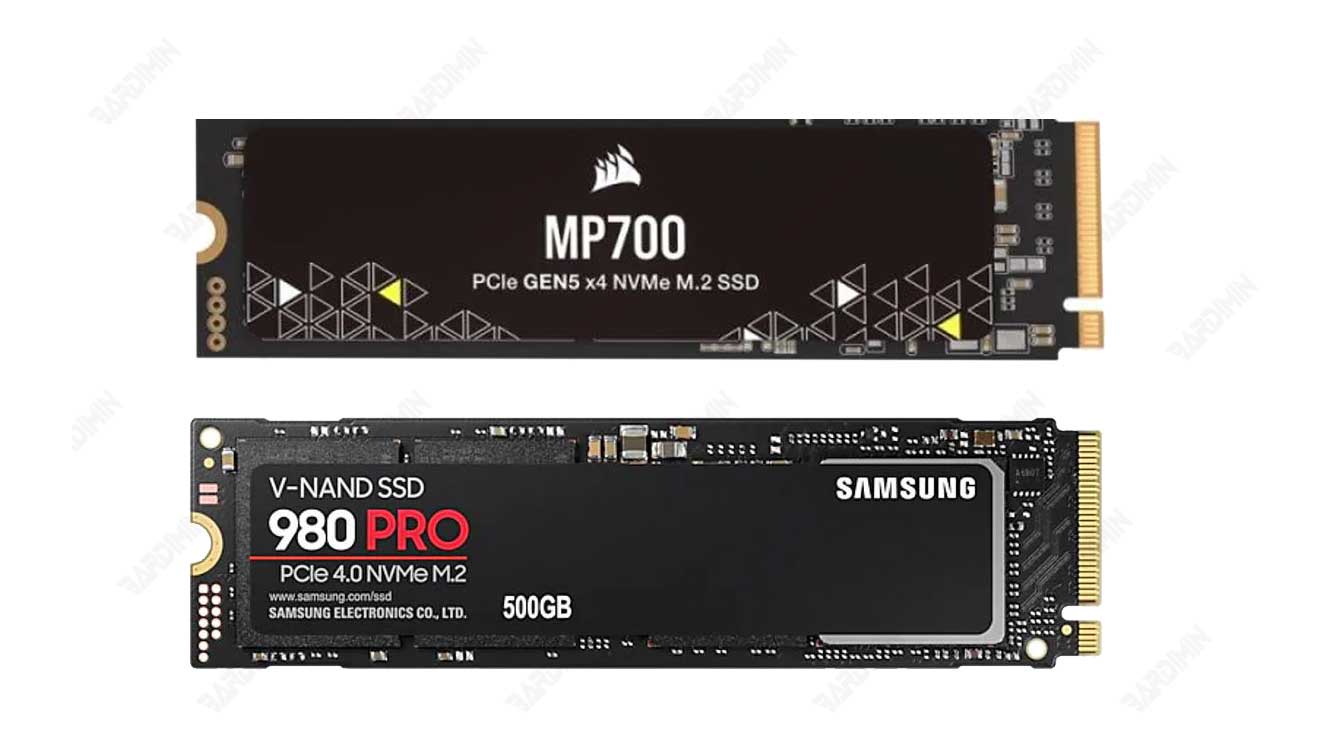
Understanding Basic Architecture: PCIe and NVMe
Before dissecting the differences between SSD generations, it’s crucial to understand the underlying technological foundations. PCI Express (PCIe) functions as a high-speed interconnection between the SSD and processor, while NVMe (Non-Volatile Memory Express) is a communication protocol specifically optimized for flash storage media.
| Component | Function | Analogy |
|---|---|---|
| PCIe Lanes | Physical data paths | Number of highway lanes |
| PCIe Generation | Speed per lane | Vehicle speed limit |
| NVMe Protocol | Communication language | Efficient traffic system |
PCIe Evolution: From Gen4 to Gen5
PCIe 5.0 delivers bandwidth of 32 GT/s per lane, doubling the capability of PCIe 4.0 which operates at 16 GT/s. In the common x4 lane configuration used by SSDs, theoretical bandwidth reaches ≈15.75 GB/s for PCIe 5.0 compared to ≈7.88 GB/s for PCIe 4.0.
This significant enhancement is made possible through improved signal integrity and implementation of Forward Error Correction (FEC) that reduces bit error rate without compromising latency.
NVMe 2.0: Protocol Refinements
NVMe 2.0 introduces several advanced features such as Zoned Namespaces (ZNS) which optimizes data writing by grouping similar information, reducing write amplification, and extending SSD lifespan. The Key Value feature enables more efficient data access for specific database workloads.
Comparative Analysis: SSD Gen5 vs Gen4
The technical differences between these two generations result in significantly different performance characteristics:
Sequential Speeds
SSD Gen5 can achieve 14,000 MB/s read and 12,000 MB/s write, while SSD Gen4 caps at around 7,000/6,000 MB/s. This difference is most noticeable in large file transfers (50GB+) and content creation workloads.
Random Performance
For critical 4K random read/write operations in gaming and daily applications, the difference isn’t as substantial as sequential speeds. SSD Gen5 leads by about 15-25% thanks to optimized controllers and faster NAND flash.
Thermal Management and Power Consumption
SSD Gen5 generates significantly higher heat output due to increased transfer speeds. Without dedicated heatsinks, thermal throttling can drastically reduce performance. Power consumption also increases 20-30% compared to Gen4 under load.
System Compatibility
SSD Gen5 requires the latest platforms like Intel Z690/H670/B660 or AMD X670/B650 with current-generation CPUs. On PCIe 4.0 motherboards, SSD Gen5 will automatically operate at Gen4 speeds.
Real-World Performance: Benchmarks and Use Cases
In practical testing, here are the actual impacts expected from SSD Gen5:
| Scenario | SSD Gen4 | SSD Gen5 | Improvement |
|---|---|---|---|
| Game Loading (DirectStorage) | 2.8 seconds | 2.1 seconds | 25% faster |
| Video Export 4K | 47 seconds | 32 seconds | 32% faster |
| File Transfer 100GB | 14 seconds | 7 seconds | 50% faster |
| OS Boot Time | 8.2 seconds | 7.5 seconds | 9% faster |
For gaming, the benefits of SSD Gen5 will become more apparent with broader adoption of Microsoft DirectStorage, enabling direct loading of game assets from SSD to VRAM without passing through system RAM.
Current Product Recommendations 2024
| Model | Generation | Capacity | Sequential R/W | Endurance | Price Per GB |
|---|---|---|---|---|---|
| Corsair MP700 Pro | Gen5 | 2TB | 14,000/12,000 MB/s | 1,400 TBW | Rp 2,750 |
| Seagate FireCuda 540 | Gen5 | 2TB | 13,500/12,300 MB/s | 1,300 TBW | Rp 2,800 |
| Samsung 990 Pro | Gen4 | 2TB | 7,450/6,900 MB/s | 1,200 TBW | Rp 1,900 |
| WD Black SN850X | Gen4 | 2TB | 7,300/6,600 MB/s | 1,200 TBW | Rp 1,850 |
Investment Decision: When to Choose SSD Gen5?
- Professional Workloads: 8K video editing, data analytics, virtualization with I/O intensive tasks
- High-End Gaming with PCIe 5.0 motherboard and preparation for DirectStorage
- Future-Proofing for systems expected to last 3-5 years ahead
When is SSD Gen4 More Rational?
- Budget-Conscious Build with performance still very adequate for most use cases
- PCIe 4.0 Platform that doesn’t support Gen5 speeds
- General Gaming and standard productivity applications
Conclusion
SSD Gen5 represents the pinnacle of current storage technology with sequential speeds almost double that of Gen4. However, the premium price and requirement for specific platforms make it relevant only for high-end users with specific workloads.
For the majority of gamers and professionals, SSD Gen4 like Samsung 990 Pro or WD Black SN850X still offers better price-to-performance ratio. Upgrade to Gen5 should only be considered when building a new system with PCIe 5.0 motherboard and adequate budget.
With the PCIe 6.0 roadmap already on the horizon, investment in Gen5 technology needs careful consideration, given the rapid ongoing development of storage technology.