

Printing photos at home is increasingly in demand in today’s digital age because it is easy, flexible, and more affordable than professional printing services. With the advancement of technology, anyone can create high-quality prints without needing a photo studio or outside print service.
Not just for personal use, many photographers, both amateur and professional, are starting to use home photo printers to print their work faster and more efficiently. Printing at home also provides greater control over the quality of the color, size, and type of paper used so that the print results can be adjusted to each person’s wishes.
However, with so many printer options available, choosing the right device can be challenging. Some printers are designed to produce high-quality photos, while others are better suited for everyday use, such as printing simple documents and images. In addition, the cost of ink or consumables is also important to consider when choosing the right printer for the long term.
In general, there are two main technologies in home photo printers: Inkjet and Dye-Sublimation (Dye-Sub). Each has its advantages and disadvantages in terms of print quality, speed, and operational cost efficiency. Bardimin will discuss these two types of printers in detail, compare their features and performance, and provide guidance on choosing the photo printer that best suits your needs.
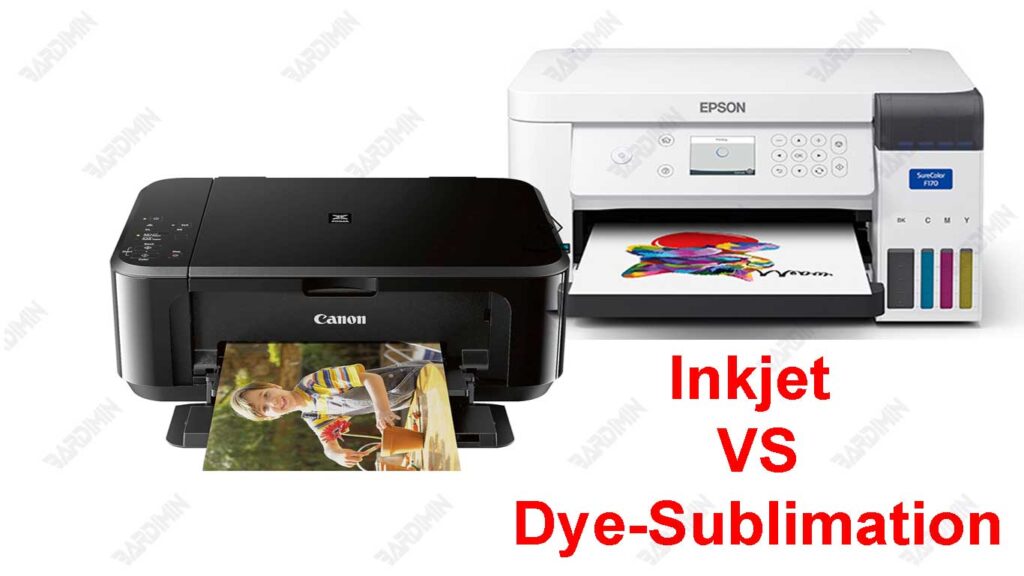
What is an Inkjet Printer?
Inkjet printers are one of the most widely used types of printers for printing photos and documents at home. This technology allows users to print high-quality images at a fairly affordable cost. The way an Inkjet printer works is by spraying small droplets of ink directly onto the paper through a very small nozzle.
Many well-known brands such as Epson, Canon, HP, and Lexmark manufacture these printers, each with different printing technologies to produce the best prints. With its ability to print color images with vivid details, Inkjet printers are the top choice for many people, both for personal and professional purposes.
How Inkjet Printers Work
Inkjet Printer Technology is designed to produce high-quality prints by spraying ink with precision. Here is a general explanation of how Inkjet printers work:
Print Mechanism
The printer is equipped with a print head that moves back and forth on the paper while printing.
Inside the print head is a small nozzle that sprays liquid ink in the form of very small droplets.
These ink droplets are arranged very precisely to create images or text that look clear and sharp.
Ink Spraying Technology
There are two main systems in Inkjet printers:
1. Thermal Inkjet (Canon, HP, Lexmark)
Thermal Inkjet technology is a method used by several well-known inkjet printer brands such as Canon, HP, and Lexmark. In this system, the printer has a small heater located close to the nozzle to heat the ink until it boils.
This heating creates ink bubbles that then “explode” and push ink droplets out of the nozzle onto the paper. Since this thermal method relies on heat, the ink used must be specially designed so that it does not dry out or clog the nozzles, thus keeping the printer‘s performance at its best. This technology is also known as BubbleJet on Canon printers.
2. Piezoelectric Inkjet (Epson)
The Piezoelectric Inkjet technology developed by Epson has a unique way of regulating ink flow. Unlike methods that use heat, this technology utilizes vibrations from piezoelectric crystals. These vibrations create pressure that pushes the ink out of the nozzle.
One of the advantages of this technology is its ability to spray ink with varying and more precise droplet sizes, thus providing better control in the printing process.
In addition, because it does not require heat, piezoelectric technology can use a variety of inks, including pigment-based inks that are more durable and stable than dye-based inks. This results in a higher quality and durable print.
Color Printing Process
The color printing process on inkjet printers utilizes CMYK’s basic color combinations, namely Cyan, Magenta, Yellow, and Black, to produce color images. Some more advanced printer models come with additional colors, such as Light Cyan, Light Magenta, or Grey, which aim to improve the quality of color gradation. In printing high-quality photos, printers typically perform multiple passes to ensure each color is applied accurately.
Advantages of Inkjet Printers
Priced
Inkjet printers generally have a more affordable starting price than Dye-Sublimation printers. It is ideal for home users who want to print photos without having to spend a fortune.
Flexible for Different Types of Molds
Inkjet printers can not only print photos but also print text documents, graphics, stickers, or labels with satisfactory quality. This tool can be used on various types of print media, ranging from glossy photo paper to matte paper to canvas.
Satisfactory Print Quality
Inkjet printers can print at high resolutions, making them ideal for printing photos with sharp details. The color ink used is also able to create beautiful color gradations, especially in images that have many color variations.
Wide Range of Print Sizes
Not only can Inkjet printers print in small sizes, but they are also available in models capable of printing up to A3 size or larger, making them ideal for professional graphic design and photography purposes. This printer uses a combination of CMYK base colors (Cyan, Magenta, Yellow, and Black) to produce color images.
Some of the more advanced models come with additional colors, such as Light Cyan, Light Magenta, or Gray, which serve to improve the quality of the color gradation. To produce high-quality photos, printers often perform multiple passes so that each color can be applied perfectly.
Disadvantages of Inkjet Printers
Slow Print Speed
Inkjet printers require multiple printhead passes to produce complete colors, so the photo printing process can take longer compared to Dye-Sub printers.
High Ink Costs
The use of ink cartridges is often inefficient because the ink runs out quickly. Some printers use cartridges that combine multiple colors, such as one cartridge for Cyan, Magenta, and Yellow, so if one of the colors runs out, the entire cartridge must be replaced. Alternatively, ink tank systems such as EcoTank can help lower ink costs more effectively.
Frequent Ink Problems
If the printer is not used for a long time, the ink in the nozzle may dry out and clog the ink line. Therefore, regular maintenance is essential to ensure print quality is maintained.
Less Durable on Some Types of Paper
Inkjet printers are more prone to fading when exposed to water or high humidity, especially when using dye-based inks compared to pigment-based.
What is a Dye-Sublimation (Dye-Sub) Printer?
Dye-Sublimation (Dye-Sub) printers are a type of printer that uses special technology to print high-quality images, especially for small-sized photos such as postcards. Unlike Inkjet printers that spray ink onto paper, Dye-Sub printers use a heat process to transfer colors from a special ribbon to the paper. This technology is often used in portable photo printers or printers that are specifically designed to print photos.
How Dye-Sub Printers Work
Dye-Sub printers use ribbons that contain three main colors: cyan, magenta, and yellow. This tape serves as a color source for printing images.
The color from the tape is transferred to the paper through a heating process. The heat generated by the printer causes the dye (dye) on the sublimation tape to change from a solid form directly to a gas and then stick to the special paper that has been prepared.
Each color is printed separately. This process is carried out layer by layer, starting from cyan, magenta, and yellow until finally producing a smooth and high-quality image. Some Dye-Sub printers also add a protective layer to improve print durability.
Advantages of Dye-Sub Printers
Almost Perfect Print Quality
Since the colors are printed in a transparent layer, the Dye-Sub prints have very smooth color gradations and sharp details. This makes it ideal for printing professional-quality photos.
Durable and Resistant to Fading
Prints from Dye-Sub printers are known to be more durable as compared to Inkjet prints. The resulting color is more resistant to fading, especially if exposed to UV rays or light exposure for a long time.
Color Consistency
The Dye-Sub printing process produces consistent and accurate colors, making it suitable for printing photos that require precise color reproduction.
Disadvantages of Dye-Sub Printers
Higher Operating Costs
Dye-Sub printers require special tape and paper that must be replaced regularly. The cost of replacing this tape and paper can be more expensive compared to the cost of ink and paper on an Inkjet printer.
Limited Print Size
Most Dye-Sub printers are designed to print small photos, usually a maximum of 6 x 4 inches (postcard size). If you need larger photo prints, a Dye-Sub printer may not be the right choice.
Slower Print Speed
The Dye-Sub printing process takes longer because each color is printed separately. This makes it less efficient if you need to print in large quantities or with limited time.
Inkjet vs. Dye-Sublimation Printer Comparison
Choosing between Inkjet and Dye-Sublimation printers depends on the user’s primary needs, whether they are more concerned with flexibility, operational costs, or photo print quality. Here is a complete comparison of the two types of printers based on various important aspects:
Print Quality
| Aspects | Inkjet Printers | Printer Dye-Sublimation |
| Type of Mold | Suitable for text, image, and photo documents | Especially for high-quality photos |
| Detailed Images | Good, but sometimes it looks grainy if the ink doesn’t absorb perfectly | The result is smoother, as the color is applied in the form of a gas |
| Color Gradation | Good, especially for models with more color cartridges | More accurate, with more natural color transitions |
| Color Fastness | It can fade for a long time if you don’t use pigment-based ink | More durable against water, scratches, and UV rays |
If you need a versatile printer that can print photos and documents at the same time, Inkjet is a more flexible option. However, for more durable, professional-quality photo prints, Dye-Sublimation is superior.
Operational Costs
| Aspects | Inkjet Printers | Printer Dye-Sublimation |
| Printer Pricing | Cheaper at the beginning | Tends to be more expensive |
| Ink / Color Tape Cost | It can be expensive if using conventional cartridges | The color bands should be replaced at once, even if only one color is used up |
| Economical Alternatives | EcoTank or ink refill system is more economical | There is no alternative but to use a special ribbon |
| Types of Print Media | Can print on various types of paper | It can only be used with special paper |
Inkjet printers are more economical when used with a refillable ink system or EcoTank. However, if using a regular cartridge, the operating costs can be more expensive than Dye-Sublimation in the long run.
Print Speed
| Aspects | Inkjet Printers | Printer Dye-Sublimation |
| Print Text Documents | Fast, especially for printers with draft mode | Not recommended for documents |
| Print Photo | Slow, as it requires multiple print head passes to build colors | Faster and more consistent because it prints every color in one heating process |
| Dry Time | Takes time to dry, especially if using glossy paper | Instantly dries as ink seeps into the paper |
Dye-sublimation printers are faster and more practical for printing high-quality photos, but Inkjet printers are faster at printing text or graphic documents.
Tips for Choosing the Right Photo Printer
Choosing a suitable photo printer depends largely on your printing needs, operational costs, and desired quality of results. If you often print small high-quality photos, then a Dye-Sublimation (Dye-Sub) printer is a great choice because the prints are sharp, waterproof, and do not fade easily.
However, if you need a versatile printer for printing photos and documents, Inkjet printers are a better choice, especially those that use EcoTank systems or more economical ink refills.
Dye-Sub offers speed and consistency in printing photos, while Inkjet provides flexibility in print size and the type of media that can be used. Don’t forget to consider the long-term cost, as Dye-Sub requires color tape and special paper, while Inkjet can be more ink wasteful if you use a regular cartridge.
If you prioritize photo quality and durability, Dye-Sub is superior, but if you’re looking for a multifunctional printer, Inkjet remains the best choice.