

Choosing the right photo paper is essential to get a clear, durable, and color-accurate print. The quality of photo paper affects how ink absorbs and adheres to it, which impacts the detail, contrast, and durability of the image. Using plain paper to print photos often results in unvivid colors, blurry images, and uneven textures because they are not designed to absorb ink well.
In comparison, custom photo paper has a coating that can absorb ink evenly, resulting in richer colors and clearer details. For example, prints on glossy paper will look brighter with high contrast, while matte paper provides a softer look without light reflections. Therefore, choosing the right type of photo paper for your needs—whether for personal collections, professional portfolios, or art prints—will ensure the best and highest quality prints.
Getting to Know the Types of Photo Paper Finishing
Choosing the right photo paper finish is essential to get the right print. Different types of finishes have different characteristics, affecting the sharpness of details, color contrast, and durability of the mold. Here are some of the most commonly used types of photo paper finishing:
1. Glossy – Bright Colors with Clear Details
Glossy paper is the most chosen choice because it produces brighter colors and high contrast. Its glossy surface can display details with great clarity, making it ideal for brightly colored photos such as landscapes or portraits that require high clarity. However, the disadvantage is that this paper easily leaves fingerprints and has a high-light reflection, making it difficult to see from a certain angle.
2. Matte – Elegant Look Without Reflection
Unlike glossy, matte paper has a non-glossy surface, reducing light reflections, and making it more comfortable to see from various angles. The advantage is a softer and more elegant look, suitable for black-and-white photos or images that will be displayed in brightly lit places. However, since it doesn’t have a reflective layer like glossy, the details in the photo may be a little less sharp.
3. Satin / Semi-Gloss – Ideal Balance
Satin or semi-gloss paper falls somewhere between glossy and matte, offering the best combination of the two. This finish gives a smoother look than glossy but still brings out the details well without excessive light reflections. This type is suitable for different kinds of photos, especially those that will be framed and displayed under normal lighting conditions.
4. Pearl and Lustre Paper – Special Texture with Luxurious Shades
Pearl and lustre paper have a smooth surface that gives it a luxurious and professional feel. This texture helps to reduce light reflections, making it comfortable to view from different angles without sacrificing the sharpness of details. These finishes are often chosen by professional photographers for high-quality prints.
5. Fine Art Paper – An Exclusive Choice with Durable Quality
Fine Art Paper is a premium option made from special materials such as canvas, linen, or cotton, providing high-quality prints. This paper is often used for art exhibitions, professional photography, or private collections due to its long durability and high aesthetic qualities. However, due to the more exclusive material, the price of this paper is usually higher than other types.
Understanding Photo Paper Weight (GSM)
GSM (Grams per Square Meter) is a measure used to find out the weight of paper in square meters. The higher the GSM number, the thicker and heavier the paper. To measure GSM, we weigh a piece of paper that measures 1 meter x 1 meter. For example, if the paper weighs 200 GSM, it means that 1 square meter of paper weighs 200 grams. This GSM value is important for assessing the thickness and strength of the paper.
GSM (grams per square meter) is the standard measure of paper weight. A higher GSM number indicates a thicker, stronger paper. Paper with low GSM is typically thinner and plier, while paper with high GSM is more durable, especially for high-quality prints.
The weight of the paper affects the way the ink absorbs and holds on the surface. Paper with high GSM often has a special coating that better preserves color details and prevents wrinkles due to ink moisture. In addition, the heavier the paper, the more durable the print will be and the more suitable for long-term storage.
Paper Weight Recommendations Based on Intended Use
Here is a guide to choosing the weight of paper according to your printing needs:
Below 150 GSM
Ideal for printing photos in bulk or photos that will be sent by airmail. This paper is lightweight and flexible, but it is less suitable for long-term printing.
150-250 GSM
Standard for good quality photo printing. The paper in this range is thick enough to display sharp colors without warping easily, so it is often used for photo albums and everyday prints.
Above 250 GSM
It is recommended for high-quality photos to be framed. The paper is thicker and stronger, providing a more professional look and long-term resistance to moisture and environmental changes.
Common Photo Paper Sizes and Aspect Ratios
Choosing the right size of photo paper is essential for the print to match the composition of the image. Each paper size has a different aspect ratio, which can affect how the photo is printed, whether it needs to be cropped or there will be a white border around it.
Frequently Used Photo Paper Sizes
Some common standard sizes for printing photos are:
- 6 x 4 inches (15 x 10 cm): Classic size for printing snapshots from 35mm film or standard photos from DSLR cameras.
- A4 (21 x 29.7 cm): Often used for printing large photos, portfolios, or collections that you want to frame.
There are also 5 x 7 inches (13 x 18 cm) and 8 x 10 inches (20 x 25 cm) sizes that are commonly used for larger prints.
Understanding the Aspect Ratio and Its Effect on Print Results
The aspect ratio is the comparison between the width and height of an image. If the aspect ratio of the photo does not match the size of the paper, then the image must be cropped or there will be a white border around the photo. Here are some common aspect ratios:
- 3:2 ratio: Standard on DSLR and 35mm film cameras. This ratio is suitable for 6 x 4 inch photo paper, resulting in prints without cutting.
- 4:3 ratio: Common on compact cameras and smartphones. If printed on 6 x 4 inch paper, the photo should be cropped at the top and bottom, or left with a border on the side.
- 16:9 ratio: Used for panoramic or widescreen photos. If printed at a standard size, it will usually leave a large border on the top and bottom unless it is cut to the print size.
Resolution Required for Perfect Print Results
One of the important things in printing high-quality photos is adequate image resolution. A low resolution can make the image look blurry or choppy, while a resolution that is too high does not always guarantee better print quality, especially if the printer has resolution limitations. Therefore, it is important to know the exact image resolution for each print size.
Image resolution is measured in PPI (Pixels Per Inch), which indicates the number of pixels per inch in a digital image. The higher the PPI, the more detail can be displayed in the printout. To get high-quality prints, the recommended resolution is 300 PPI. If the image resolution is below this number, the print may appear blurry or pixelated.
Minimum Resolution Recommendations for Different Photo Paper Sizes
Here are the minimum resolutions recommended for printing the best-quality photos:
- 6 x 4 inches (15 x 10 cm) → Minimum 1800 x 1200 pixels (equivalent to 2.2 megapixels).
- A4 (21 x 29.7 cm) → At least 2520 x 3564 pixels (equivalent to 9 megapixels).
- 8 x 10 inches (20 x 25 cm) → Minimum 2400 x 3000 pixels (about 7.2 megapixels).
If the image has a resolution below the recommendation, the print quality may deteriorate, especially if it is enlarged beyond its original size.
Difference between Image Resolution (PPI) and Print Head Resolution (DPI)
Most of the time, people think of PPI (Pixels Per Inch) and DPI (Dots Per Inch) as the same term, when they are different:
PPI (Pixels Per Inch)
Shows the number of pixels in an inch of a digital image. This determines the clarity of the image before printing.
DPI (Dots Per Inch)
Indicates the number of ink dots printed per inch by the printer. DPI has more to do with the printer’s ability to print details. For example, a printer with a resolution of 1440 DPI does not mean printing an image at 1440 PPI but prints more ink dots to produce smoother color gradations.
Photo Paper Brand Recommendations
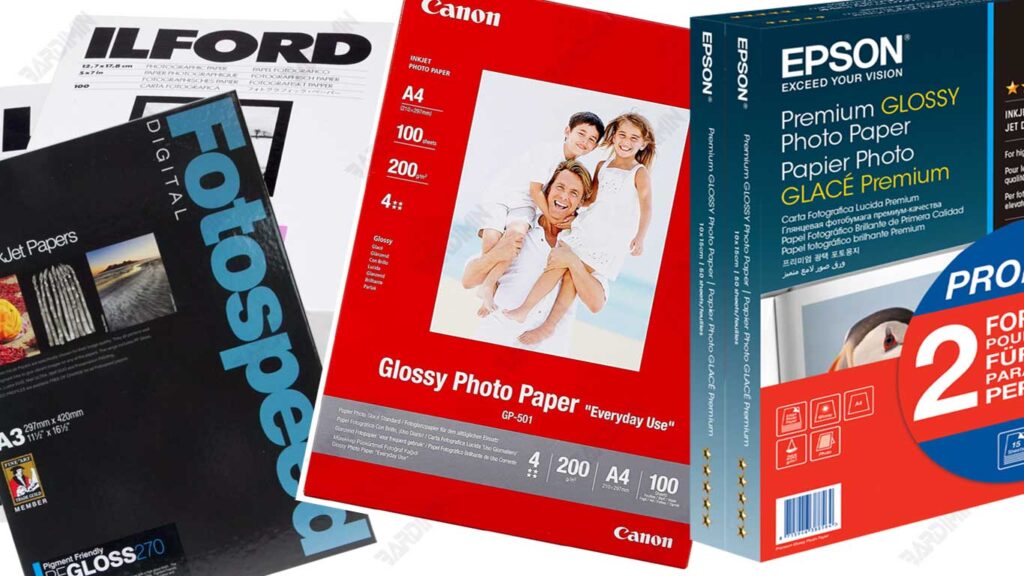
Choosing the right photo paper is essential for quality prints. Some well-known manufacturers provide different types of paper with different characteristics, such as glossy, matte, satin, and fine art paper. Here is a summary of some of the best photo paper brands on the market along with the advantages and disadvantages of each.
| Brand | Excess | Deficiency | Suitable for |
| Epson | – Premium quality, optimal for Epson printers. – Available in a variety of finishes (Glossy, Matte, Semi-Gloss). – Sharp and durable color. | – More expensive. – Best results only when used with Epson printers and original inks. | Epson printer users who want high-quality prints. |
| Canon | – Compatible with Canon printers for optimal results. – Equipped with fade-resistant technology for long-lasting colors. – Photo Paper Pro Platinum variant for professional results. | – Prices are higher than third-party brands. – Some variants are only available in certain sizes. | Canon printer users who want prints with sharp colors and durability. |
| Ilford | – The top choice for professional photographers. – Offers a variety of unique finishes (Pearl, Lustre, Satin). – Suitable for fine art prints and galleries. | – High price compared to other brands. – Less suitable for everyday or mass printing. | Professional photographers or artists who want the quality of fine art prints. |
| Fotospeed | – A choice with high quality. – Has an archival paper variant for durable prints. – Compatible with a wide range of printers without any problems. | – Not as popular as Epson or Canon, making it harder to find. – Some variants have a premium price. | Users who need high-quality paper for art or collections. |